POKEMON BOOSTER BOX: PULL RATES, EXPECTED VALUE, AND WHAT YOU'RE ACTUALLY BUYING
Pokemon booster boxes contain 36 packs with randomized pull rates averaging 1-2 Special Illustration Rares. Most boxes run negative expected value vs buying sin
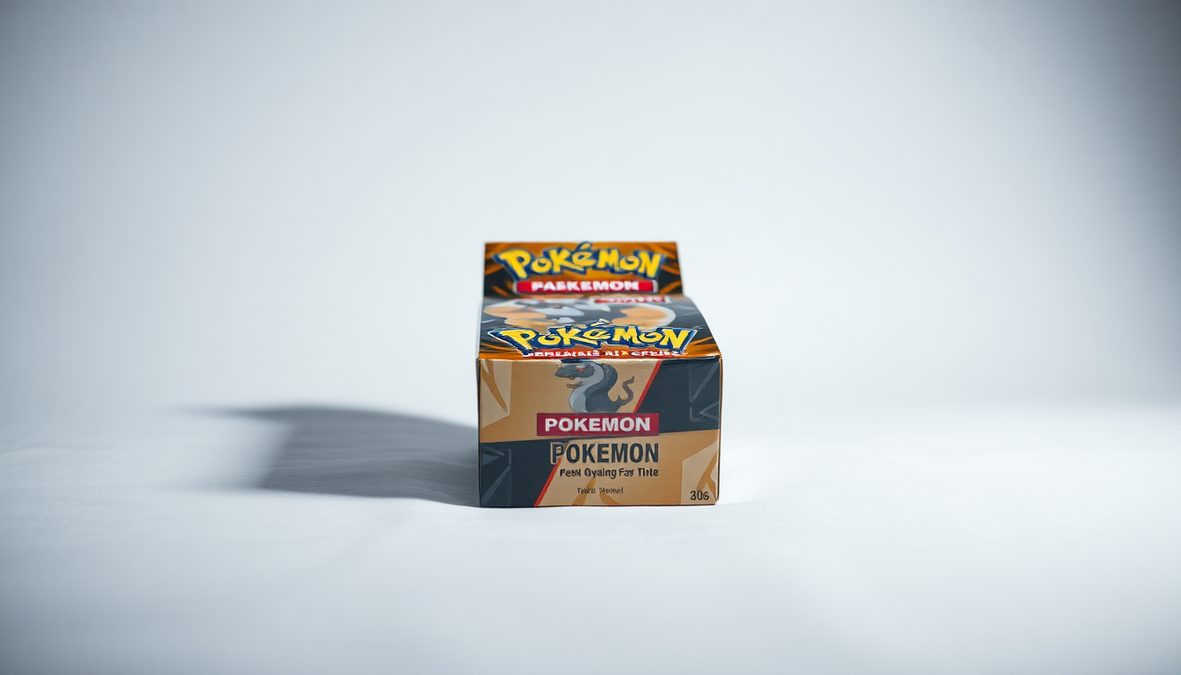
You're staring at two options on TCGplayer: a single Prismatic Evolutions booster pack for $6.50 or a sealed booster box for $189. The math says buying 36 packs individually costs $234, so the box saves you $45. But that's not the real question. The real question is whether either option gets you anywhere near the Eevee Hero SARs you're chasing, or if you're just lighting money on fire with extra steps.
A Pokemon booster box contains 36 booster packs from the same set, factory-sealed in official Pokemon wrapping. That's it. No guaranteed chase cards, no better pull rates than individual packs, no secret algorithm that rewards box buyers. You're purchasing probability in bulk with a discount for commitment.
How Pokemon Booster Boxes Work
Pokemon organizes their sealed product into a clear hierarchy. Booster boxes sit at the top of the individual purchase ladder — above single packs and three-pack blisters, below case purchases (6 boxes per case for most modern sets).
Each box contains 36 packs. Modern Japanese sets give you 30 packs. Ten cards per pack for English main sets, five cards for Japanese sets. The math compounds quickly: one English booster box delivers 360 cards, though bulk commons and uncommons make up 288+ of those slots.
Manufacturing happens at different facilities. English cards print primarily at Cartamundi facilities in the US and Europe. Japanese cards print in Japan. This matters for quality control. Japanese boxes show tighter centering, fewer print lines, and more consistent card stock. If you're buying to grade, Japanese boxes have structural advantages before you ever crack a pack.
Pull Rate Structure
Pokemon doesn't publish official pull rates. We calculate rates by tracking thousands of box openings across multiple sources — pack opening videos, community spreadsheets, case break data from shops.
Here's what English boxes deliver on average:
Illustration Rare: 3-4 per box (12:1 pack ratio)
Ultra Rare (ex cards, Full Art supporters): 4-5 per box (7-8:1 ratio)
Special Illustration Rare: 1-2 per box (18-24:1 ratio)
Hyper Rare (Gold cards): 0-1 per box (36+:1 ratio)
Surging Sparks boxes averaged 1.4 SIRs per box across 500+ tracked openings. That's better than Temporal Forces (0.9 per box) but worse than Paldean Fates (1.8 per box, smaller subset).
Japanese boxes run different math. Booster boxes contain 30 packs with roughly 1 SAR per box. But Special Art Rares occupy different rarity tiers. The Umbreon ex SAR from Snow Hazard sat at 1:100 packs. You'd need 3-4 boxes to statistically hit one copy.
Modern Horizons 3 Collector Booster boxes (different TCG, useful comparison) guarantee specific slot structures. Pokemon doesn't work that way. You could open a Prismatic Evolutions box and pull zero SIRs. Someone else pulls three. Over thousands of boxes, rates stabilize. Over one box, variance destroys budgets.
Box Mapping and Random Distribution
Box mapping died around 2016-2017. Earlier Black & White and XY boxes had discoverable pack weight patterns and pull sequencing. Scalpers would weigh packs (holographic cards added microscopic weight) or track pull positions (chase cards appeared in predictable pack slots within a box).
Pokemon randomized distribution starting with Sun & Moon. Packs within a box now have randomized weights and positions. You can't weigh them. You can't map them. Pack position means nothing.
Some collectors still believe in "better packs" within a box. They'll save certain packs for last, or rip from specific box positions. Superstition. Ten thousand tracked openings show no correlation between pack position and hit rates.
Cases (6-box units) sometimes show non-random distribution. We've documented Paradox Rift cases where 2-3 boxes contained most illustration rares while other boxes pulled dry. But you're probably not buying cases. And even case-level patterns don't help when stores break cases and sell individual boxes.
Expected Value: What a Pokemon Booster Box Actually Costs You
Expected value (EV) calculation is simple: average market value of all possible pulls multiplied by their pull rates, minus box cost.
Prismatic Evolutions boxes currently sell for $189. Let's calculate EV based on TCGplayer market prices from late January 2025:
Top chase cards:
Pikachu ex Special Illustration Rare: $280
Eevee ex SAR: $165
Leafeon ex SAR: $95
Glaceon ex SAR: $92
Umbreon ex SAR: $78
You'll pull roughly 1.2 SARs per box. But that's distributed across nine different SIR cards. Your odds of hitting specifically Pikachu are 1:18 boxes. Most boxes pull a mid-tier SAR worth $40-80.
Standard Ultra Rares average $8-15 in this set. You'll pull 4-5 of them. Call it $50 total. Illustration Rares contribute another $15-20 across 3-4 pulls. Everything else — your 340 commons, uncommons, and reverse holos — bulk sells for $0.50 per thousand cards.
Reality check: The average Prismatic Evolutions box yields $140-160 in market value. You paid $189. That's negative $30-50 EV before shipping, before fees if you're selling, before the time cost of grading or listing cards.
Temporal Forces runs worse. Boxes cost $110. Average box value sits at $75-85. Ancient Booster Roar Entei SIR carries the set at $180, but appears in roughly 1:20 boxes. Most boxes contain draft chaff.
Japanese sets flip the equation. Wild Force boxes cost $65-70. The Iono SAR alone sells for $120. Pull rate sits at 1:120 packs (4 boxes). Other SARs in the set add value. Your average box pulls $80-90. That's positive EV, but only because print runs are smaller and English reprints don't exist.
When Boxes Have Positive EV
Newly released sets sometimes offer brief windows of positive EV. Obsidian Flames boxes cost $120 at release. Charizard ex SAR hit $320 in week one before settling at $175. Early boxes returned $160-180 average value.
The window closed within three weeks. Supply increased. Prices corrected. Current Obsidian Flames boxes cost $95 and return $70-80 value.
151 boxes maintained positive EV for six months due to Mew ex Special Illustration Rare at $240-280 and Erika's Invitation SAR at $150-180. High hit rates (two guaranteed ex cards per box) created consistent value. Boxes that cost $155 at release returned $180-200 average value through early 2024.
Why this matters: You're not investing. You're gambling with defined edges. The house (Pokemon) prints enough product to ensure negative long-term EV for most boxes. Short-term EV opportunities exist but require immediate action and willingness to sell into hype.
Common Misconceptions About Pokemon Booster Boxes
"Booster Boxes Have Better Pull Rates Than Individual Packs"
False. Pull rates are identical whether you buy 36 individual packs or one sealed box. The pack contents get randomized during manufacturing. The box is just cardboard housing.
The misconception stems from guaranteed pulls. A box almost certainly contains multiple Ultra Rares because 36 packs at 7:1 odds yields 5-6 hits mathematically. Buying 36 individual packs across three months creates the same probability, but you might buy them from different print runs or wave releases, creating perceived variance.
Some players swear their local game store has "hot" single packs. Confirmation bias. They remember the Umbreon ex pull from a random blister, forget the 40 packs that contained nothing.
"You Should Always Buy Sealed Booster Boxes Over Individual Packs"
Depends entirely on what you're doing. Cracking packs for fun? Buy what your budget allows. Singles satisfy the same itch at 1/6 the cost.
Chasing specific cards? Buy singles. The Pikachu ex SAR costs $280. Booster boxes cost $189. You'll open 2-3 boxes ($378-567) before probability favors pulling one. Just buy the card.
Building competitive decks? Definitely buy singles. Players don't crack boxes to construct Charizard ex decks. They buy four Charizard ex for $60 total and move on.
The only time boxes make mathematical sense: you're a sealed collector who values sealed product, or you're drafting with friends and need pack quantity, or you're content-creating and need volume for videos.
"Japanese Booster Boxes Are Always Better Value"
Better card quality, yes. Better value? Situational.
Japanese boxes cost less ($60-80 vs $110-190 for English boxes) but contain fewer packs (30 vs 36). Per-pack cost runs similar. Pull rates are different but not universally better — you're getting approximately 1 SAR per Japanese box compared to 1-2 SIRs per English box, but the subset sizes differ.
The real value in Japanese boxes comes from three factors:
Grading premiums. Japanese cards grade PSA 10 at 2-3x the rate of English cards. Better quality control means higher grade percentages mean better ROI on grading fees.
No English equivalents. Cards like Vaporeon VMAX Character Rare from Eevee Heroes don't exist in English. You're accessing exclusive pulls.
Lower print runs. Japanese sets typically see smaller production volumes. Prices hold better long-term.
But shipping costs $20-40 from Japanese retailers. Import times run 2-4 weeks. And if you're buying to resell into the English market, your buyer pool shrinks to collectors who specifically value Japanese cards.
Practical Implications for Pack Openers and Collectors
Buy booster boxes if you value the opening experience and accept negative expected value as entertainment cost. A $189 Prismatic Evolutions box delivers roughly three hours of opening entertainment if you're filming or opening with friends. That's $63/hour for entertainment. Expensive, but cheaper than concert tickets.
Don't buy boxes if you're chasing specific cards or building wealth. The math doesn't support it. Buy singles.
Don't buy boxes from third-party marketplace sellers unless they're established shops with return policies. Resealed boxes plague eBay and Facebook Marketplace. Scammers use heat guns to open factory shrink wrap, remove chase cards, replace them with bulk, and reseal. Only buy from legitimate retailers — TCGplayer verified sellers, Card Kingdom, Gamenerdz, your local game store.
If you're buying older boxes (Crown Zenith, Silver Tempest, anything pre-2023), check sold listings on eBay before buying. Many older boxes now cost more than their EV because sealed collectors create demand. Brilliant Stars boxes cost $140-160 but contain maybe $90-100 in average pulls. You're paying a sealed premium.
Grading Economics from Booster Boxes
PSA grading costs $25-35 per card at bulk rates (20+ cards). You'll submit 4-6 cards per box on average — your Ultra Rares and any well-centered illustration Rares.
Here's where most people fail the math. That Glaceon ex SAR worth $92 raw? PSA 10 sells for $180. Sounds like $88 profit. But:
PSA fee: $30
Shipping to PSA: $15 (insured)
Return shipping: $8
PSA 9 rate on modern English cards: 35-40%
PSA 9 Glaceon ex sells for $85-95. You paid $53 in grading and shipping to move a $92 card sideways. PSA 8 brings $45-55 — you lost money.
Only grade cards worth $80+ raw where PSA 10 sells for 2.5x+ raw price. Iono SAR from Wild Force: $120 raw, $380 PSA 10. That's submittable. Most box pulls don't meet this threshold.
Japanese cards flip the math. Pull rate quality means 60-70% PSA 10 rates on major chase cards. Your grading costs stay the same, but your success rate doubles.
Related Topics: Booster Bundles, Elite Trainer Boxes, and Single Packs
Booster bundles (those 6-pack cardboard carriers at big box stores) cost $25-30. That's $4.17-5 per pack vs $5.25 per pack when buying a full booster box. Worse value, identical pull rates. Skip them unless it's the only option.
Elite Trainer Boxes include 9 packs plus dice, sleeves, and energy cards. They cost $50-60. You're paying $5.55-6.67 per pack, but getting accessories worth maybe $10-15 to collectors. Terrible value if you only want packs. Decent value if you're new and need sleeves and damage counters.
Single packs at $4-5 from local game stores work if you're buying one or two packs for immediate gratification. You're paying the convenience premium. No mathematical advantage, but also no commitment to burning $189 on a full box.
Sleeved boosters (single packs sold in plastic blisters with promo cards) run $5-7. That promo card is worthless. You're paying $1-3 extra for cardboard packaging. Hard pass unless the promo is actually relevant (rare).
Build & Battle boxes give you four packs plus a fixed promo card and evolution-focused subset. They cost $25-30. Competitive players buy them for the promo if it's playable (Charizard ex from Obsidian Flames Build & Battle). Collectors should skip — the four packs run you $6.25-7.50 each.
The hierarchy of value (best to worst): Booster box > Individual packs > Elite Trainer Box > Booster bundle > Sleeved blister > Build & Battle.
Should You Buy a Pokemon Booster Box Right Now?
Prismatic Evolutions: No. Boxes cost $189 for $140-160 EV. Wait for reprints to drive box prices to $140-150, or buy singles.
Surging Sparks: Maybe. Boxes dropped to $115-125. EV sits at $100-110. If you're opening for fun and accept the $10-15 loss as entertainment cost, it's defensible. The Pikachu ex 229/191 at $180 and Alolan Exeggutor ex SIR at $95 create chase card excitement.
Temporal Forces: No. Terrible set. Boxes cost $110 for $75-85 returns. The only chase card is Ancient Roar Entei at $180, appearing in 1:20 boxes. You'll need $2,200 in boxes to statistically pull one.
Paldean Fates: If you can find them under $100. Boxes hit $130-140 at release, now available for $95-105. EV runs $90-100, but Iono ex SAR ($280), Farigiraf ex SAR ($110), and high SIR rates (1.8 per box) make it fun to open.
Paradox Rift: No. Dead set. Boxes cost $90-95. EV is $55-65. Ancient Booster Iron Valiant ex ($85) and Roaring Moon ex ($65) are the only cards worth anything, but they're regular ex cards at elevated prices because the set is terrible.
Japanese sets: Wild Force and Cyber Judge boxes cost $65-75. Combined EV across both sits at $140-160 per set (you need both to complete the pull pool). If you're patient, buying singles still wins. If you value Japanese card quality and accept slight negative EV, these boxes are less punishing than most English releases.
Bottom line: Most Pokemon booster boxes are negative EV purchases. You're buying entertainment, not investing. If you understand that and want 36 packs of lottery tickets, go ahead. If you want specific cards or long-term value, buy singles and sealed vintage product instead. The Pikachu ex SAR you're chasing costs $280. Don't spend $567 on three boxes hoping probability saves you.