MTG BOOSTER BOX: WHY MOST PLAYERS OVERPAY AND HOW TO ACTUALLY CALCULATE VALUE
MTG booster box guide: Draft vs Collector, pull rates, expected value math, and why most players lose money cracking packs at release.
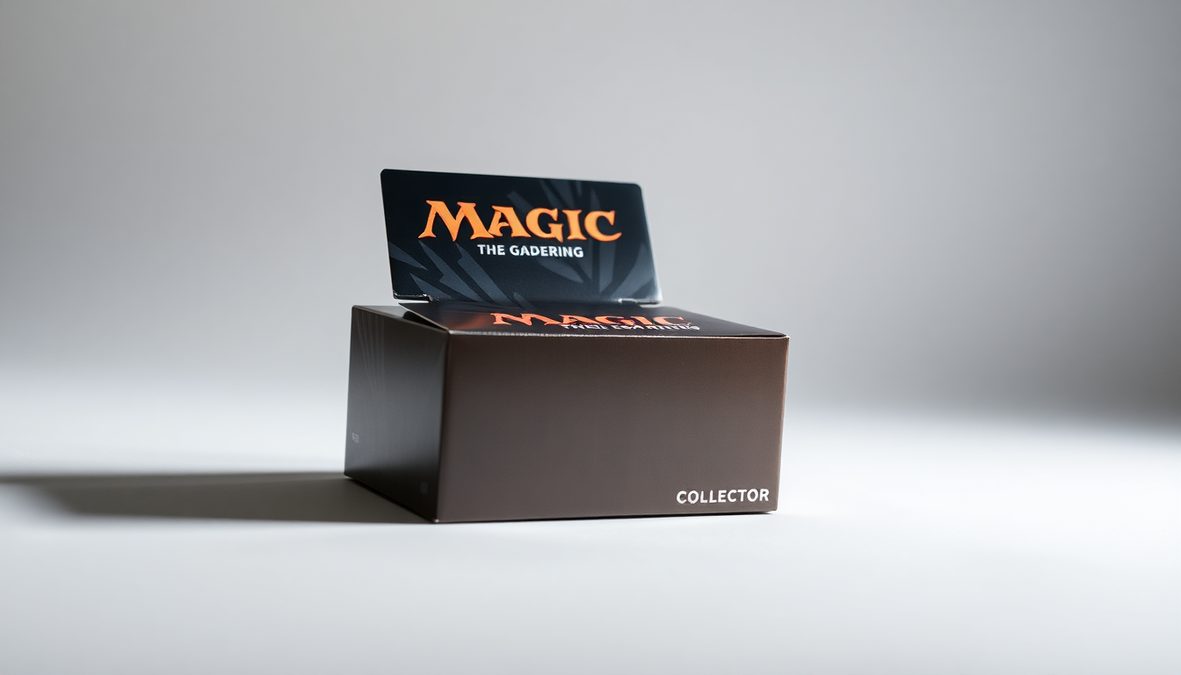
Most Magic: The Gathering players buy booster boxes at the worst possible time—right at set release when prices peak and expected value craters within weeks.
An MTG booster box contains 36 booster packs from a single set, designed as the bulk product for stores, draft organizers, and collectors chasing chase cards. You'll pay $90-$140 for Standard sets, $200-$300 for Masters sets, and $250+ for premium releases like Modern Horizons 3 or The Lord of the Rings: Tales of Middle-earth. But here's what no one tells you: boxes from most Standard sets lose 30-40% of their value within three months as singles prices collapse and big box stores discount inventory.
The math is brutal. A Wilds of Eldraine booster box cost $110 at release. Six months later, TCGplayer market price: $78. Total value of singles you'd pull from average box: $65. You're underwater before you even crack pack one.
How MTG Booster Boxes Work
Each booster box contains 36 booster packs. Standard set boxes include Draft, Set, and Collector variations—each with different card pools and pull rates. Draft boxes ($90-110) contain standard 15-card packs with 1 rare/mythic, 3 uncommons, 10 commons, and 1 land. Set boxes ($110-130) replace commons with more connected cards and include an art card. Collector boxes ($200-250) stuff every pack with special treatments: foils, extended art, showcase frames, borderless versions.
Modern Horizons 3 collector boxes illustrate the premium tier perfectly. $320-360 retail. Each pack guarantees 4 rares/mythics (compared to 1 in draft packs), plus serialized cards, textured foils, and retro-frame treatments. Pull rates shift dramatically: you're looking at roughly 1 borderless mythic per 3 packs versus 1 per box in draft. That's why Modern Horizons 3 collector boxes held $340-370 three months post-release while draft boxes dropped from $260 to $210.
Masters sets occupy the middle ground. Commander Masters draft boxes started at $280, contained high-reprint-value legends and expensive staples, but crashed to $190 within eight weeks. Why? Wizards printed it into the ground. Print run matters more than card list.
Draft vs. Set vs. Collector Booster Boxes
Draft boxes serve limited formats and casual cracking. You get bulk rares, draft chaff, and occasional bombs. Expected value on Standard draft boxes typically ranges 55-75% of purchase price at set release, dropping to 45-60% by month three. Murders at Karlov Manor draft boxes cost $105 at launch with pulls averaging $68 per box. Current price: $85, average pulls: $58. Negative EV compounding.
Set boosters aim at pack-cracking dopamine without draft requirements. Wildcard slots, list cards (reprints from Magic's history), art cards, and guaranteed foils create variance. The List includes cards like Concordant Crossroads ($18), Muscle Sliver ($12), or bulk like Ranger's Guile ($0.10). Set boxes run 10-15% higher than draft, but expected value rarely justifies the premium unless you're specifically hunting List hits or enjoy the slot variability.
Collector boosters chase whales. Every card gets premium treatment—foil, alt-art, extended art, showcase frame, something. Serialized cards (1/500 or even 1/1 copies) appear in recent sets at microscopic rates. Modern Horizons 3 included serialized textured foil fetches at roughly 1:3,000 packs. That's $9,600 in collector packs to statistically hit one. The Ugin's Fate Ugin, the Spirit Dragon 1/1 sold for $35,000. But you're not hitting that. You're hitting textured foil Harbinger of the Seas at $18 and calling it a win.
Pull Rates and Odds Breakdown
Standard sets follow consistent mythic/rare distribution. Draft boxes guarantee 36 rares/mythics. Statistical distribution: 1 mythic per 7.4 packs, meaning 4-5 mythics per box average. Chase mythics appear at roughly 1:30 boxes for the absolute top card. Wilds of Eldraine's Beseech the Mirror hovered at $28-32 for months—you'd crack 30 boxes ($3,300) to statistically pull one.
Borderless and showcase treatments vary wildly. Borderless planeswalkers in Standard sets appear roughly 1:24 draft packs. Phyrexia: All Will Be One had borderless Elesh Norn, Mother of Machines at 1:144 draft packs (4% of boxes pull one). She peaked at $90, now sits at $32. If you spent $576 buying four boxes to statistically secure one, you'd lose $544 after pulling her.
Collector boxes compress these odds. Modern Horizons 3 collector packs contain 1 extended-art rare minimum, 2 traditional foil rares/mythics, and special slot options. Fetch land pull rates: roughly 1 regular extended-art fetch per 2.5 collector packs, or 4.8 per box. Misty Rainforest extended art non-foil trades at $21. Five pulls nets you $105 from just fetches—but you paid $340 for the box. The other $235 needs to come from Eldrazi, planar cards, and serialized lottery tickets.
Common Misconceptions About MTG Booster Boxes
Misconception: Booster boxes always contain better cards than buying single packs.
Wrong. Wizards doesn't seed boxes with guaranteed chase cards beyond basic rare/mythic distribution. Your $110 draft box might contain 36 bulk rares worth $0.25 each ($9 total value). I've opened Thunder Junction boxes with zero rares above $3. That's not bad variance—that's expected outcome for 40% of boxes in mediocre sets. The "box mapping" era ended years ago, but print runs still create clusters where entire cases contain no premium hits.
Card Kingdom's bulk rare section proves this daily. They list hundreds of recent set rares at $0.25-0.75. Outlaws of Thunder Junction has 80+ rares below $1. If your box hits 30 of those and six $2-4 cards, you've pulled $35-45 from a $105 investment. Buying singles would cost you $35-45 total. You gambled $60-70 on nothing.
Misconception: Collector boxes guarantee profit because they contain premium cards.
Collector boxes offer better expected value percentages (often 70-85% of purchase price) but rarely profitable outcomes. Murders at Karlov Manor collector boxes cost $210-230 at release. Average pulls: $165. You're down $45-65 per box before fees, shipping, or time spent listing 300+ cards on TCGplayer.
The variance argument holds water only if you're cracking volume. Open one box, pull badly, lose $80. Open twenty boxes, approach statistical averages, still lose $900-1,300 but at least you got your dopamine hit 720 times. This isn't investing—it's entertainment with costs.
Misconception: Sealed booster boxes appreciate like vintage sealed product.
Modern print runs dwarf vintage availability. Wizards prints Standard sets into oblivion. Stores received so much Thunder Junction that distributor prices hit $80-85 per draft box within three weeks of release. You can't create scarcity when Amazon warehouses hold 10,000-unit inventory.
Compare to Alpha or Beta boxes—vanishingly rare, historic, impossible to reprint. Those appreciate. A Battle for Zendikar box purchased at $100 in 2015 now sells for... $110-120. Nine years, 10-20% appreciation, underperforming basic index funds by 180%+. Original Zendikar boxes ($100 in 2009) now command $550-700, but that's the exception from an era of smaller print runs and higher card-level demand (fetch lands, playable rares).
Modern Horizons sets do appreciate—MH1 boxes cost $200 at release (2019), now trade at $320-380. That's real growth, but driven by exceptional reprint value (Force of Negation, Urza, Wrenn and Six) and genuine scarcity relative to demand. MH2 boxes went $215 to $290 over three years. These are premium sets with eternal format staples, not Standard chaff.
Practical Implications for TCG Collectors and Pack Openers
Buy singles unless you're drafting or treating box opening as entertainment. The math screams this truth. If you want four specific rares from Murders at Karlov Manor, buying them costs $8-20 total. Cracking boxes until you pull all four costs $300+ on average. You'll accumulate bulk, duplicates, and cards you don't need.
Exception: you plan to draft with friends. Draft boxes at $85-95 divided among eight players costs $10.60-11.90 per person for three hours of gameplay. That's reasonable entertainment pricing. You keep the cards, someone pulls the chase rare, everyone drafts decent decks. Fine.
Wait 6-12 weeks after release to buy boxes if you're determined to crack packs. Standard set prices crater as stores blow through inventory. Thunder Junction launched at $105-110, hit $85-90 by week eight, bottomed at $80 by week twelve. You saved $25-30 per box by exercising basic patience. Modern Horizons 3 stayed elevated longer (month four: still $250-270 for draft, $340-360 for collector) because Wizards controlled print run better and card demand held.
TCGplayer's Direct program often shows distributor overstock. When stores list 50+ boxes of a set below Market Price, that signals print run excess. Buy then, not at preorder when FOMO peaks.
Track expected value using TCGplayer Market Price data, not retail. Sellers list Murders at Karlov Manor mythics like Vein Ripper at $8.50. You won't get $8.50—you'll get $6.50-7.00 after fees, buylist offers, or trade-in values. Calculate expected value at 75-80% of market price for realistic outcomes.
Run the numbers before buying. Modern Horizons 3 collector box at $340? Pull rate data shows average value of $270-290. You're paying $50-70 for the experience of opening packs. If that's worth it to you, fine. Just don't pretend you're making money.
When MTG Booster Boxes Actually Make Sense
You're organizing a draft pod regularly. Splitting a box among eight players delivers cost-effective limited play. You'll run three draft rounds, keep the cards, and spend roughly $11 per person. Beat that value at any game store.
You run a TCG shop or content channel. Opening boxes generates inventory (shop owners) or content (YouTube/Twitch streamers). You'll recoup costs through sales or ad revenue. This isn't collection advice—it's business operations.
You specifically enjoy variance and pack-cracking psychology. Some people love lottery-ticket pulls. They're not deluding themselves about expected value—they're paying for entertainment. Acknowledge it costs money, budget accordingly, don't rationalize it as investing. Totally valid if you're honest about it.
You're buying premium sets (Modern Horizons, Masters series) from print-to-demand runs that maintain value. MH3 boxes at $260 with $220-240 expected value represent reasonable entertainment cost relative to card quality. Every rare sees potential eternal format play. Compare to Standard sets where 60% of rares are draft chaff worth quarters.
How to Minimize Losses on Booster Boxes
Buy from Amazon or big-box retailers during sales. Target occasionally runs 15-20% off gift card promotions. Combined with RedCard 5% discount, you're looking at 20-25% off MSRP. A $110 box at $83 with $75 expected value hurts less than full retail.
Preorder only sets with proven reprint equity or unique mechanics. The Lord of the Rings: Tales of Middle-earth warranted preorders because it featured The One Ring serialized chase (1:1 sold for $2 million), Sol Ring reprints, and IP crossover appeal. Murders at Karlov Manor featuring Ravnica detective mechanics? Wait for discount. The set was fine, not chase-worthy.
Crack boxes immediately or never. Holding sealed Standard product for "future value" traps capital in slowly depreciating assets. Either open now while cards maintain release-window prices, or commit to 5+ year holds on proven sets. Don't warehouse Wilds of Eldraine boxes hoping they'll appreciate—they won't.
Buylist your bulk immediately to stores like Card Kingdom or Star City Games. Yes, you'll get lower prices than TCGplayer market, but you'll move 200+ cards instantly without listing fees, shipping costs, or time investment. Pulled $80 in marketable cards from a $95 box? Buylist for $52, take your $43 loss, move on. Better than watching those cards depreciate to $60 market/$40 buylist over six months while you procrastinate listing them.
Related Topics: Navigating the MTG Sealed Product Ecosystem
Set Rotation and Value Decay: Standard sets rotate from competitive formats annually, cratering prices on most rares. Cards legal in Pioneer, Modern, or Commander maintain value better. Before buying boxes, check format legality and reprint risk.
Grading Sealed Booster Boxes: PSA and CGC grade sealed boxes from older sets. Alpha boxes graded PSA 7-8 command huge premiums over ungraded ($50,000+ versus $30,000). Modern boxes see minimal grading premiums unless packaging perfection matters. Don't grade your Thunder Junction box hoping for value—it's a $90 product with $85 expected value regardless of wrapping condition.
Bundle and Preconstructed Products: Commander precons and bundles offer better value for specific cards. Commander Masters precons contained $40-60 in singles for $40-45 retail. Bundles deliver set boosters, storage boxes, and promos at reasonable prices. These aren't gambling—you know what you're getting.
International Market Pricing: Japanese or European booster boxes sometimes cost 20-30% less than US retail, but import duties, shipping costs, and language barriers complicate purchases. Japanese collector products see dedicated demand for alternate art treatments not available in English. Research thoroughly before importing.
You'll do better buying singles 95% of the time. Booster boxes serve limited formats, provide entertainment value, or make sense for content creators and shop owners. They're rarely investments and frequently destroy wealth through negative expected value. Calculate before you crack.